Axon is being built in public. The core is stable and shipping. More phases are on the way — follow the roadmap. Follow the progress →

Cognitive Flow Oriented · v0.4.0

The open-source language where agents become architecture.

Stop chaining prompts. Start engineering systems. Axon gives you a runtime, a memory model, and a flow language — so what you build today scales into something real tomorrow.

Cognitive flows Native functions Open source
Provider activo Ollama · local + OpenAI · Anthropic · Cohere — Phase 5
research_pipeline.axon
Runtime
Search Analyst Summarize
✓ 62/62
Tests passing
62/ 62
Runtime
C++17
Paradigm
CognitiveFlow
Memory types
5native types of memory available

Paradigm shift

Programming has always evolved toward a higher level of abstraction.

Each era solved the problem of its time. Axon solves the one of this era.

1950s
Assembly
"Talk to the hardware"
Every instruction was a direct command to the processor. Powerful. Fragile. Specialists only.
1970s
C
"Talk to memory"
Pointers, stack, heap. The programmer controls where each piece of data lives and when it dies.
1990s
Java
"Talk to objects"
Memory gets abstracted. The focus shifts to modeling the world as entities and relationships.
2000s
Python
"Talk to libraries"
Objects get abstracted. The focus shifts to composing existing functionality, not building it.
2020s
LLMs
"Talk to prompts"
Natural language becomes the interface. Powerful — but without structure, without contracts, without a runtime.
Now
Axon
"Coordinate intelligence."
This isn't a syntax change. Actors have state, contracts and a lifecycle. The runtime orchestrates execution the way an operating system would.
v0.4.0 · available

Runtime

An operating system for intelligence.

Axon doesn't run on top of another language. It has its own runtime compiled in C++17 — with a thread scheduler, an execution graph with cycle detection, and a finite state machine per actor.

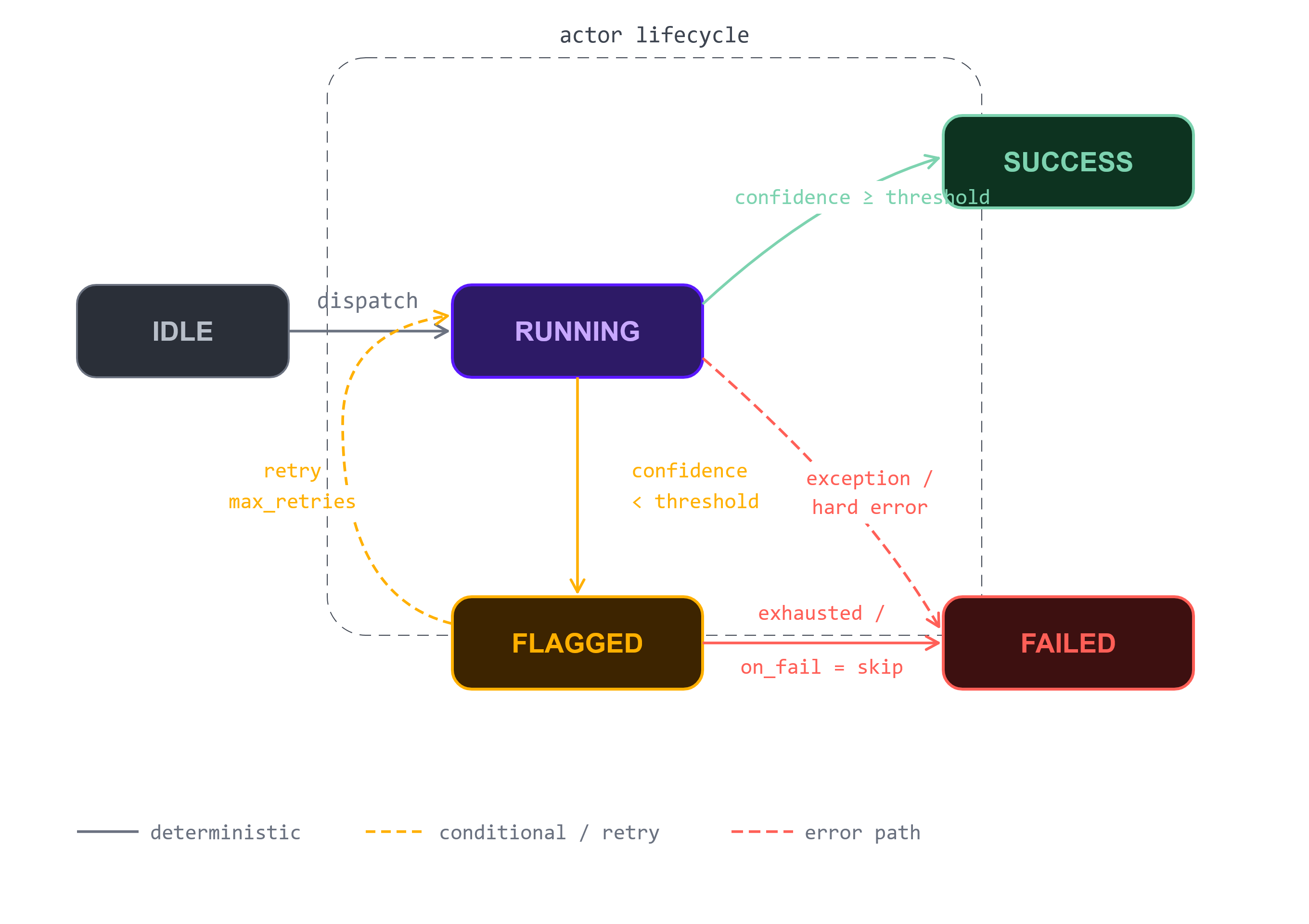
Each actor moves through well-defined states. If it fails, the runtime decides what happens next according to the declared contract — not according to imperative code the developer forgot to write.

Actor lifecycle — Finite State Machine
IDLE RUNNING SUCCESS/ FAILED/ FLAGGED

What an operating system does for processes, Axon does for actors: lifecycle, memory, communication and concurrency — managed by the runtime, not written by hand.

Build once. Run anywhere. Scale to millions.

Powered by the Axon Runtime
Philosophy

Principles that don't change with versions.

Most frameworks evolve by changing their foundations. Axon will evolve by expanding them.

01
Declarative where ir matters, imperative where you need it
Actors, memory and validation are contracts you declare. The orchestration logic in main {} is code you write. Both live in the same file. Neither gets in the way of the other.
02
Explicit over implicit
Memory scope, failure behavior, retries, compute target — everything is visible in the code. No hidden state that surfaces in production. No magic that works until it doesn't.
03
Native runtime, no interpreter overhead
The runtime is compiled in C++17. No Python, no Node, no virtual machine with a GIL. The host is native, the thread pool is real, and latency matters when intelligence is in the loop.
04
Flows, no scripts
An Axon project has real structure: a single entry point, declared actors, logic in main. It's not a notebook. It's not a prompt chain held together with string concatenation. It's engineering.
05
Scales whitout rewriting
The same flow running on your laptop today can become a distributed system tomorrow without touching the actor logic. The infrastructure changes. The code doesn't.
06
Built in public
Open RFC, visible roadmap, honest state of every feature. What exists today, what's coming in the next phase, and what's long-term vision — marked with clarity. No vaporware.

Universal Computational Graph

From an initial flow to a result. No depth limit.

Every node has a type and a contract.
A flow starts execution, triggers agents, which run tasks, which can invoke other agents or entire flows —
forming an execution network that the runtime traces, validates and optimizes.

Memory System

memory_example.axon


Five memory types. One syntax.

Each actor declares what it remembers and for how long. No hidden state — the memory model is explicit, managed by the runtime, and observable in every execution.

R
runtimeper actor · ephemeral
Lives only while the actor executes. Dies with the process — ideal for context that shouldn't survive a single second longer than necessary.
S
sessionper flow · ephemeral
Shared between all actors in the same flow during execution. Enables real coordination without coupling one actor's code to another.
SH
sharedglobal to the flow · ephemeral
All actors read and write to the same space, without restrictions. The common workspace for the entire flow.
P
persistentglobal · survives · .bin
Key-value with optional TTL that survives between separate runs of the program. Written to disk and recovered in any future execution.
SE
semanticglobal · survives · .idx
HNSW index + native embeddings. Searches by meaning and context, not by exact text match. Persists as a single portable file.

Parallel Runtime

parallel {} is not a promise.
It's a thread pool.

When you write parallel {} in Axon, the C++17 scheduler assigns each actor to a real worker in the thread pool — not to an event queue, not to cooperative coroutines taking turns.

No GIL. No interpreter yielding control between instructions. Every core does its work in true parallel, and the runtime synchronizes the results when all of them finish. The same code takes advantage of 4 cores on your laptop and 64 on a production server — without changing a single line.

Inside a parallel {} block you can mix completely different agents — with different models, different tasks, and different memory — and the runtime coordinates them as if they were one.

C++17
Thread pool
0
GIL overhead
N
Real Cores
Thread pool · Real simultaneous execution
parallel_example.axon


core 0
Researcher
72%
core 1
Validator
85%
core 2
Reviewer
60%
core 3
idle
30%

Compute

compute_config.axon

      
CPU
Native thread pool
C++17 · no GIL · real workers per core available
GPU
CUDA · ROCm · fallback
NVIDIA · AMD · CPU auto-fallback if CPU is not available

Your hardware. Your rules. Zero waste.

Axon doesn't assume your infrastructure. Each agent declares exactly how it wants to run — which hardware, how many layers on GPU, how many CPU threads. The runtime enforces it. No guesswork, no silent fallbacks you didn't ask for.

Adaptive by design
compute = auto tries GPU first and falls back to CPU silently. compute = gpu forces it. compute = cpu never touches the GPU. You decide — the runtime respects it.
Per-agent granularity
Different agents in the same flow can target different hardware. Run your heavy model on GPU with num_gpu = -1 and your lightweight validator on CPU with num_thread = 4 — simultaneously.
GPU crash recovery
Set gpu_fallback = true and the runtime automatically retries on CPU if the GPU returns a hard error. Your flow keeps running. Nothing breaks silently.
VRAM-aware configuration
Control how many model layers go to GPU with num_gpu, enable f16_kv to halve KV cache memory usage, or activate low_vram mode for constrained environments.

Transport Layer

Interconnect machines, environments and clouds.

Axon is not tied to a single machine. Your flows can connect local instances, networked servers, and cloud services using the same actor model — without changing the flow logic.

RESTavailable
Standard HTTP. Compatible with local Ollama, remote APIs, and any endpoint you need to talk to.
transport rest · endpoint "localhost:11434"
gRPCavailable
Low latency, bidirectional streaming. Ideal for connecting internal services or nodes in the same datacenter.
transport grpc · endpoint "interno:50051"
API ProvidersPhase 5
OpenAI, Anthropic, Cohere, and more — same actor syntax, same validation contract, different provider.
provider openai · model "gpt-4o"
Distributed MeshPhase 8
Point-to-point encrypted channel with ChaCha20 between runtime nodes on different machines or cloud regions.
mesh { encryption = "chacha20" · key = env:KEY }

Consensus in design · open RFC

What if the system could reach a conclusion on its own?

Consensus is a module where multiple actors debate a decision. Each one with its own context and accumulated accuracy history — the runtime knows who has been right before and gives them more weight in the collective decision.

The result is not just a "yes" or a "no". It's a traceable decision: which actors voted for what, why the ones with higher accuracy tipped the balance, and what arguments the dissenters presented.

Collective intelligence with full traceability. Not a black box — a panel with minutes.

Use cases: evaluate whether to ship a feature · audit code from multiple perspectives · validate strategy with specialized actors · hiring decisions · risk analysis

Contribute to the RFC →
Consensus · simulationin design
Discussion topic
"Should we ship the distributed mesh feature in Phase 6?"
Discussion
ArchitectYes — the runtime foundation supports it0.91
QA LeadNo — insufficient test coverage0.88
ProductYes — roadmap demand0.62
SecurityNo — encryption without audit0.55
Result
Runtime concensus
Delay launch — prioritize test coverage and encryption audit.
The two actors with the highest history (Architect 0.91, QA Lead 0.88) diverge. The runtime applies weight by accumulated confidence: QA Lead prevails due to Product and Security's history of false positives in previous decisions.
dissenters: Architect, Product · registrado en flow.consensus_log

Working in Progress

What already works, and what's left to build.

A direct look at the implementation state of the language — no marketing roadmap, the real state of the code today.

ImplementedN features
Core — types, operators, control flowRuntime C++17 · Lexer · Parser · Interpreter
Compute — GPU/CPU with automatic fallbackcompute = auto · gpu_fallback = true
Native I/O file with auto-detecciónCSV, JSON, DOCX, XLSX, PDF, TXT
5 type of memory + semantic HNSWruntime, session, shared, persistent, semantic
Multi-flow, imports, compositionFlow1()->Flow2(Flow1.output)
parallel {} · real thread pool · not GILScheduler C++17
Shell interopshell {}
Errors with context file:line62/62 tests passed
In progess · pending6 features
API Providers — OpenAI, Anthropic, CoherePhase 5 · Next active phase
Web scraping / HTMLPhase 4C · pending
RAG pipeline + fine-tuning LoRAPhase 7 · in development
Consensus moduleOpen RFC · in design
Distribute Mesh · ultrasonic protocolPhase 8 · long-term version
Core implemented 75%
GitHub
Source code, open issues and RFCs in discussion. Development happens here, in public.
View the repository →
RFC · Consensus
The Consensus module is in design. If you have ideas about how it should work, this is the discussion.
Contribute to the RFC →
Discord
Questions, projects in progress, feedback on the language — the community building with Axon.
Join →